If you are looking for vape vending machines for sale, the smartest choice is not just any cabinet that dispenses products. The right machine needs to combine reliable age verification, cashless payment, remote monitoring, secure product storage, and a smooth buying experience that does not frustrate adult customers. In this category, a modern smart vending machine is closer to a self-service retail terminal than a traditional vending unit. It should help protect compliance, reduce labor pressure, improve inventory visibility, and create a cleaner customer journey from ID check to payment to product delivery. When the machine, software, product mix, and service model all work together, the result is a scalable retail setup that feels professional and performs like a serious business tool.
Why Age Verification Changes Everything
In this category, age verification is not a bonus feature. It is the foundation of the entire business model. A machine that simply accepts payment and drops a product is not enough. Operators need a system that can guide the customer through an age-check process, unlock payment only after approval, and store transaction records that can be reviewed later if needed.
That is why buyers comparing vape vending machines for sale should focus less on cosmetics and more on control systems. A polished cabinet can attract attention, but the long-term value comes from the software logic, payment integration, hardware stability, and the quality of the verification workflow. The machine has to work as a secure retail point, not just a metal box with slots.
A strong setup usually includes the following:
- ID or document scanning capability
- Rule-based age thresholds
- Audit logs for completed transactions
- Remote machine management
- Cashless payment support
- Secure locks and controlled dispensing
- Cloud-based inventory and sales reporting
Without those elements, the machine may look useful on day one but become a headache once real customers start using it. With them, the machine becomes a dependable self-service kiosk that can support repeat sales and cleaner operations.
What Buyers Really Want When They Start Comparing Machines
Most people searching for vape vending machines for sale are not just looking for a product listing. They are trying to solve three problems at once. First, they want to know if the machine can actually make money. Second, they want to know which machine type is worth buying. Third, they want confidence that the setup will feel safe, stable, and commercially practical.
That means any serious buying decision should answer all of the following:
- Will the machine help increase sales without adding more staff time?
- Will the age-verification process be fast and dependable?
- Will the payment system work smoothly with modern customer habits?
- Will the machine handle the right product sizes and packaging types?
- Will the operator be able to track stock, downtime, and performance remotely?
- Will the numbers still make sense after fees, service, and replenishment costs?
From a practical operating standpoint, the biggest mistakes usually happen when people focus too much on machine price and not enough on machine logic. A cheaper unit with weak monitoring, poor support, or limited age-verification tools may cost less upfront, but it often costs more later in service calls, refund issues, customer frustration, and lost time.
What a Strong Vape Vending Machine Should Include
A good machine in this segment should feel like a controlled retail station. The customer should understand what to do within seconds. The operator should be able to check sales, stock, and machine status without visiting in person. The hardware should look clean and modern, but the real strength should be in the parts the customer never sees: the backend, the payment stack, the remote controls, and the verification flow.
Here are the most important features to look for:
- Large touchscreen for clear customer guidance
- Cashless payment with card, mobile wallet, and contactless support
- Remote monitoring for sales, stock levels, and machine status
- Flexible lane layout for different vape product dimensions
- Secure cabinet construction and anti-theft design
- Stable dispensing system that reduces jams
- Cloud dashboard with reporting and alert tools
- Age verification that is built into the transaction flow
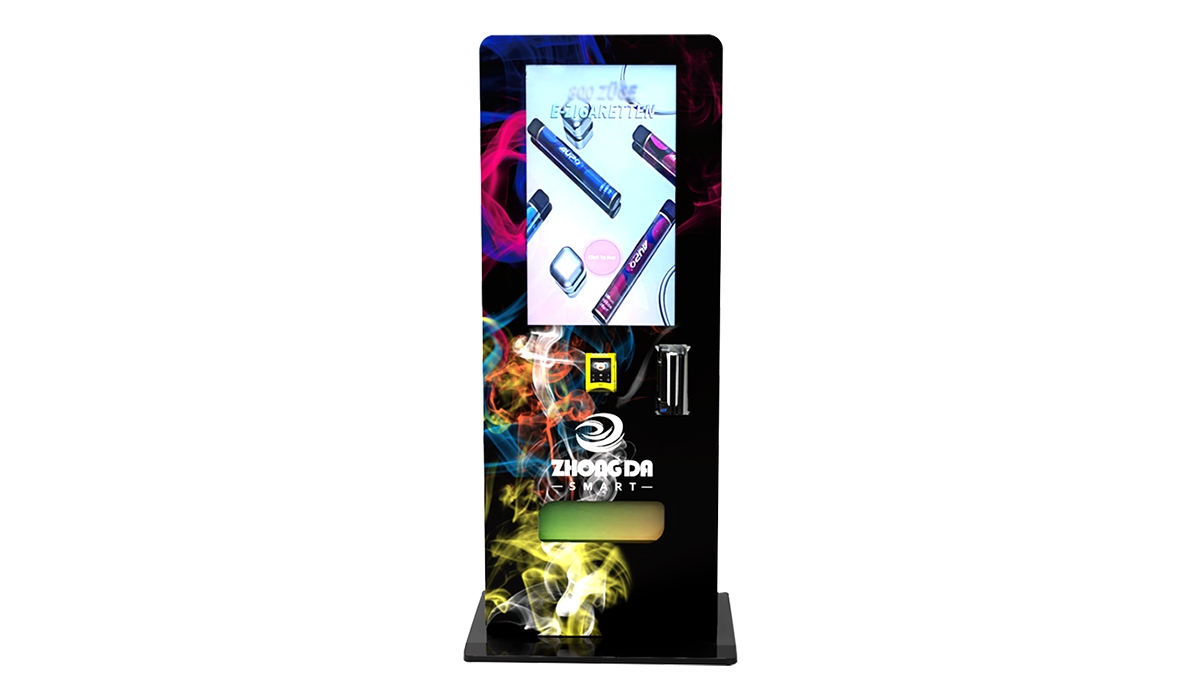
Zhongda Smart is worth considering here because its live product pages already show a dedicated category for vape machines, including compact wall-mounted models and a larger touchscreen machine with age verification support. Buyers who want to compare formats can start with the vape vending machine collection and then review the 32-inch touchscreen vape vending machine for a more advanced setup.
Quick Comparison: Basic Machine vs Smart Machine vs Age-Gated Machine
| Feature | Basic Vending Machine | Smart Vending Machine | Age-Gated Vape Machine |
|---|---|---|---|
| Payment | Cash or limited card support | Card, mobile wallet, contactless | Cashless payment strongly preferred |
| User Interface | Buttons or small display | Touchscreen navigation | Touchscreen with guided verification flow |
| Product Layout | Standard lanes only | Adjustable configuration | Adjustable configuration for vape products and accessories |
| Remote Monitoring | Minimal or none | Real-time telemetry | Real-time telemetry plus transaction records |
| Age Verification | None | Optional add-on | Core system feature |
| Audit Trail | None | Basic sales logs | Sales logs tied to verification workflow |
| Operator Value | Lower upfront cost | Better visibility and control | Higher control, stronger trust, better long-term fit |
This is why a serious buyer should not compare only cabinet dimensions or list price. The right machine is the one that supports repeatable operation, smooth customer use, and cleaner control over the entire transaction.
Choosing the Right Machine Format
There is no universal machine size that works for everyone. The best format depends on how many products you want to carry, how often you plan to restock, how much visual impact you want, and how much floor space is available. In real operations, the machine should match the product plan and the service routine, not the other way around.
Wall-Mounted Models
Wall-mounted units are ideal when space is limited or when the assortment is intentionally focused. They work well for operators who want a small footprint, fast installation, and a cleaner layout with a curated product list rather than a full category assortment.
They are often a strong fit for:
- Compact product menus
- Smaller floor plans
- Limited-SKU trial programs
- Accessory or add-on product sales
- Locations where a sleek presentation matters
Vertical Touchscreen Machines
A full-size vertical unit usually gives better merchandising, stronger screen visibility, more flexible product capacity, and more room for a smoother customer journey. This format works especially well when the goal is to present multiple devices, pods, disposables, and related accessories in a way that feels organized and professional.
This format is often the better choice for:
- Broader product variety
- Higher daily transaction goals
- Premium visual presentation
- Larger average basket size
- Operators planning for future scale
Custom Configurations
Some operators need more than a standard shelf layout. They may want special branding, custom payment integration, a revised age-verification process, different lane dimensions, or a cabinet designed for specific packaging. In those cases, a custom machine is often a smarter long-term choice than forcing a standard cabinet to do a job it was not designed for.
For buyers exploring that route, Zhongda Smart also offers a custom vending machine solution, which is useful when the goal is to build a more tailored retail setup instead of buying a generic cabinet.
How the Best Age-Verification Flow Works
The strongest age-verification setup is simple from the customer’s point of view and strict from the operator’s point of view. The process should be quick, easy to understand, and difficult to bypass. If the machine creates too many steps, people abandon the purchase. If it creates too few controls, the business becomes exposed.
A strong real-world sequence usually looks like this:
- The customer starts the shopping session.
- The machine requests ID or document scanning.
- The system checks the age rule.
- Payment is activated only after successful approval.
- The selected product is dispensed.
- The system stores the transaction record for review.
This kind of process matters because it keeps the interaction clean while still creating a record of the control steps that took place. Zhongda Smart also publishes information about its age-verification system and machine compatibility. Buyers who want to understand the manufacturer background behind those product options can review the company profile as part of supplier evaluation.
One important lesson from field operations is this: speed matters. The best age-check experience is not the one with the most dramatic security language. It is the one that confirms eligibility quickly and lets the transaction continue with confidence. Long delays and repeated scan failures kill conversion.
Can Vape Vending Machines Be Profitable?
Yes, they can be profitable, but only when the machine is treated like a retail business asset, not a passive-income fantasy. Many first-time buyers assume the hard part is choosing the machine. In reality, the hard part is building a repeatable model around the machine: product mix, restocking, payment performance, service response, and operating discipline.
A well-chosen machine can support attractive economics because it can:
- Operate long hours without extra staffing
- Support quick, cashless transactions
- Reduce labor spent on routine selling tasks
- Provide data that helps refine the assortment
- Improve stock visibility and refill planning
- Create a more controlled and consistent customer journey
At the same time, profit depends on more than revenue. Operators have to account for all the less glamorous numbers:
- Gross margin by SKU
- Payment processing fees
- Service and maintenance reserve
- Restocking labor
- Downtime risk
- Failed transaction cost
- Inventory shrink and product damage
- Commission or site fee if applicable
The broader vending industry still shows strong commercial relevance. Grand View Research estimates the retail vending machine market at $15.02 billion in 2024, which helps explain why operators continue investing in more advanced, more specialized self-service formats. That number does not guarantee success for every operator, but it does confirm that modern vending remains a meaningful retail channel.
A Practical ROI Formula Before You Buy
Before comparing suppliers, run a realistic payback model. Do not build the forecast around optimistic assumptions. Use conservative daily transaction counts, realistic refill schedules, and honest cost estimates.
A simple model looks like this:
Monthly Sales
Average transactions per day × average ticket × days open
Monthly Gross Profit
Monthly sales × gross margin percentage
Monthly Operating Cost
Payment fees + refill labor + service reserve + software cost + site fee
Monthly Net Operating Profit
Gross profit − monthly operating cost
Estimated Payback Period
Total machine investment ÷ monthly net operating profit
If the payback period still looks healthy after conservative assumptions, the opportunity may be worth pursuing. If the numbers only work under perfect conditions, the placement or product plan is probably too weak.
The Factors That Usually Decide Success
After years around vending operations, I have seen the same truth repeat itself: most underperforming machines do not fail because the cabinet was too small or the screen was too dim. They fail because the operating model was weak. Here are the five things that matter most once the machine is live.
1. Placement Quality
The machine needs consistent, repeat adult traffic. A stylish machine in the wrong setting will not make up for poor commercial fundamentals. Good placement beats fancy hardware almost every time.
2. Product Discipline
Too many SKUs create confusion and complicate replenishment. Start with products that have strong turnover and stable packaging. Expand only when the sales data supports it.
3. Uptime
A machine that is offline, jammed, or unable to complete age checks destroys customer trust quickly. Uptime is one of the most important profit drivers in the entire model.
4. Refill Rhythm
The fastest way to lose sales is to let your best-moving items go out of stock. Good telemetry helps, but it only helps if the operator uses it to plan timely service.
5. Verification Reliability
If the age-verification process is weak or inconsistent, the operator will eventually become cautious, limit usage, or stop expanding. Reliable control is what makes growth possible.
How to Evaluate a Manufacturer Properly
Many buyers make the mistake of comparing manufacturers by brochure language alone. A better method is to ask direct operational questions and see which supplier gives clear, confident, specific answers. The stronger manufacturers usually welcome those questions because they know their hardware and software can stand up to scrutiny.
Ask every supplier the following:
| Question | Why It Matters |
|---|---|
| What exact age-verification method is supported? | You need to know how the machine actually controls access. |
| Can the system store and export transaction logs? | Clear records are important for internal review and accountability. |
| What payment options are compatible? | Payment flexibility directly affects conversion and customer convenience. |
| How adjustable are the product lanes? | Packaging dimensions vary more than many first-time buyers expect. |
| What happens when verification fails? | Edge-case handling affects customer experience and support workload. |
| Is the backend cloud-based? | Remote visibility reduces wasted trips and improves control. |
| What spare parts and support process are available? | Downtime is one of the most expensive problems in vending. |
| Can the interface and branding be customized? | Better presentation often improves customer trust and completion rate. |
| What is the realistic lead time? | Rollout timing affects launch plans and capital use. |
This kind of comparison is far more valuable than asking which machine is “best” in the abstract. The best machine is the one that fits the actual business plan and operating conditions.
Why Zhongda Smart Deserves a Place on the Shortlist
If you plan to compare manufacturers seriously, Zhongda Smart deserves a close look. The company already presents a dedicated vape machine lineup, offers age-verification-oriented product options, and supports custom development. That matters because many buyers do not need a generic machine. They need a machine that can be adapted to their screen preference, lane layout, software flow, or branding plan.
From a buyer’s perspective, the advantage of working with a source manufacturer is flexibility. A source factory is usually in a better position to handle cabinet changes, hardware variations, and workflow adjustments than a reseller working from a limited catalog. That becomes even more important when the machine has to align with a specific product assortment or a custom front-end experience.
For operators comparing vape vending machines for sale, that means Zhongda Smart is not relevant just because it sells machines. It is relevant because it shows a clear product category, a larger age-verification-ready touchscreen machine, and a separate custom solution path. That is the kind of structure serious buyers should pay attention to.
My Advice on Picking the Right First Machine
If this is your first machine, do not assume the largest cabinet is the safest choice. Bigger is not always better. A machine should fit the business you can actually operate well, not the business you imagine you might run one day.
Choose based on:
- The number of SKUs you can manage consistently
- The packaging dimensions of your core products
- The speed and simplicity of the customer journey
- Your ability to restock regularly
- The visual role the machine needs to play
- The level of customization you actually need
For many operators, a mid-size or vertical touchscreen model is the smartest first step. It gives enough room for a disciplined assortment, enough screen space for a clear buying path, and enough presence to feel like a premium retail station. A compact model can also be a smart entry point when the plan is to test a limited assortment before expanding.
What Products Should Go Inside the Machine?
One of the easiest ways to weaken performance is to overload the machine with too many choices. A better approach is to build the assortment around clarity, turnover, and refill efficiency. Customers buy more easily when the menu is focused. Operators work faster when the lane plan is simple.
A strong launch assortment often includes:
- Best-selling disposable devices
- Closed-system pods with reliable turnover
- A limited number of hardware SKUs
- Compatible accessories
- Higher-margin add-on items
Items to avoid at the beginning include:
- Too many slow-moving variants
- Products with irregular or oversized packaging
- Fragile items that are likely to jam or shift
- Items that complicate replenishment without adding enough margin
- Large numbers of similar-looking SKUs that slow customer choice
The rule is simple: build for velocity first, novelty second. A disciplined product mix is usually more profitable than a crowded one.
Why Cashless Payment Is No Longer Optional
The best machines in this category are built around cashless transactions. Customers expect speed, and operators need cleaner reporting. A machine that depends heavily on cash handling is already behind where modern retail behavior has gone.
Cashless systems matter because they support:
- Faster checkout
- Lower cash-handling burden
- Cleaner transaction records
- Better support for age-verification flow
- Less friction during repeat purchases
That is one reason a smart vending machine tends to outperform a traditional cabinet in this category. It is not just more modern. It is more practical from an operating perspective. A stronger payment flow usually means fewer failed purchases, better reporting, and a more polished customer experience.
Trust, Professionalism, and Customer Confidence
This type of machine gets judged more critically than ordinary vending. Customers notice whether the screen flow is clean, whether the payment steps make sense, whether the cabinet looks secure, and whether the machine seems professionally managed. If anything feels improvised, confidence drops immediately.
A good machine should communicate five things the moment the customer sees it:
- The process is controlled
- The purchase is secure
- The machine is easy to use
- The products are presented clearly
- The operator has invested in a professional retail experience
That level of presentation matters because trust affects conversion. A customer is more likely to complete the purchase when the machine feels stable and credible. An owner is more likely to keep expanding when the system creates order instead of uncertainty.
A Realistic Example From the Field
I have seen this pattern more than once. An operator buys a low-cost machine because the cabinet looks acceptable and the price seems attractive. At first, everything feels fine. The screen turns on, the machine dispenses, and the early transactions create a false sense of security.
Then the real problems begin. The card reader becomes inconsistent. The stock data is inaccurate. Packaging shifts inside the lane and causes jams. The age-verification process is slow or unreliable. Refunds begin to pile up. The operator starts making more site visits than expected. By then, the cheap machine is no longer cheap.
By contrast, a better-built machine with stable telemetry, smoother payment flow, a more reliable dispensing system, and integrated age-verification logic usually costs more at the start but creates less friction over time. That is why long-term operators almost always prefer stronger control over lower upfront price.
Final Thoughts
The best vape vending machines for sale are the ones that combine age verification, dependable cashless payment, remote management, secure dispensing, and a customer flow that feels fast and natural. Buyers who focus only on cabinet size or machine price usually miss the real drivers of performance. In this segment, uptime, transaction control, clear reporting, and product fit matter far more than surface-level features.
If your goal is to build a machine program that can scale cleanly, buy like an operator. Study the verification flow, the machine layout, the payment options, the support process, and the quality of the backend tools. A strong self-service kiosk should do more than sell products. It should protect the business, support better decisions, and make each transaction smoother for the right customer. For buyers looking at source manufacturers with a dedicated vape lineup and customization capability, Zhongda Smart is a name that belongs on the shortlist.
Frequently Asked Questions
Are vape vending machines worth buying?
They can be, provided the machine is built around real operating needs rather than impulse buying. The right setup can reduce labor pressure, support longer selling hours, improve stock visibility, and create a more consistent customer experience. The wrong setup can create service headaches and weak returns.
What is the most important feature in a vape vending machine?
Age verification is the most important feature because it affects the entire transaction flow and the long-term viability of the machine. After that, the next most important factors are cashless payment, remote monitoring, lane flexibility, and dispensing reliability.
Should I choose a compact machine or a full-size model?
A compact machine is often better for limited assortments and smaller spaces. A full-size model is usually better when you want stronger visual presentation, more SKUs, and a more premium customer experience. The correct answer depends on your product plan and service routine.
Why is a source manufacturer better than a reseller?
A source manufacturer is often better positioned to support custom layouts, software adjustments, branding changes, and long-term parts support. That flexibility matters in a category where transaction flow and machine logic are just as important as cabinet structure.
How can I improve the return on investment?
Start with a focused assortment, keep fast-selling items in stock, minimize downtime, use real-time monitoring data, and choose a machine that reduces failed transactions. Most return problems come from weak operations, not from a lack of customer interest.