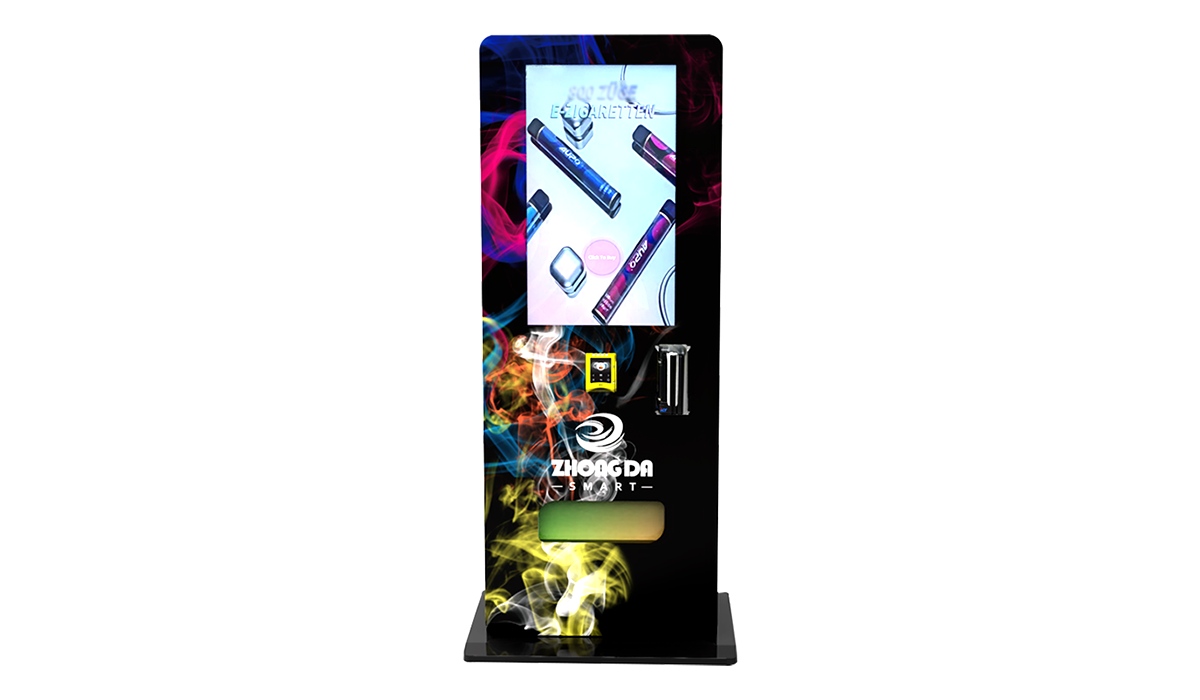
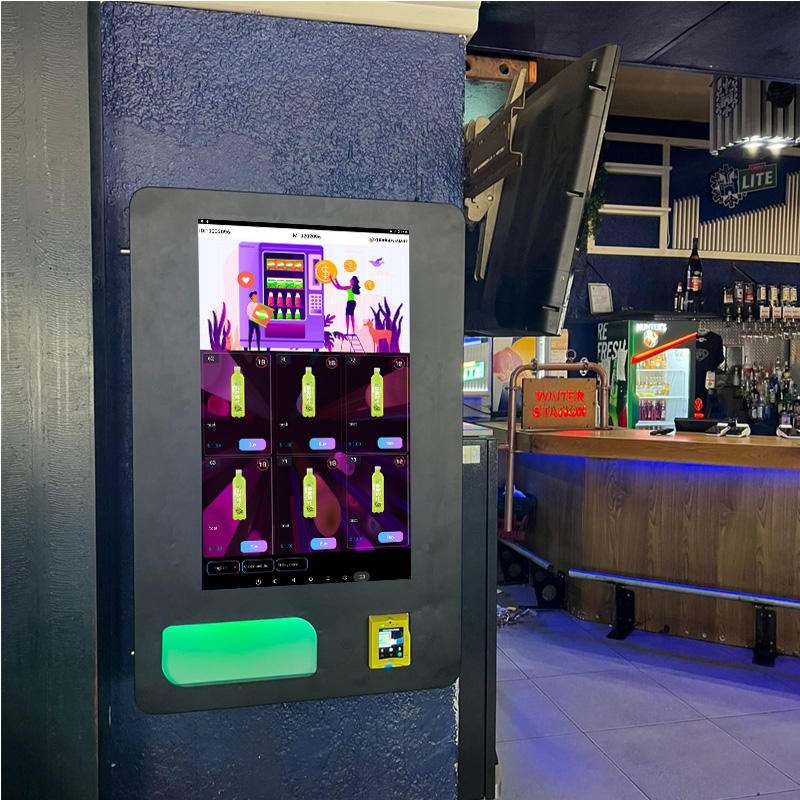
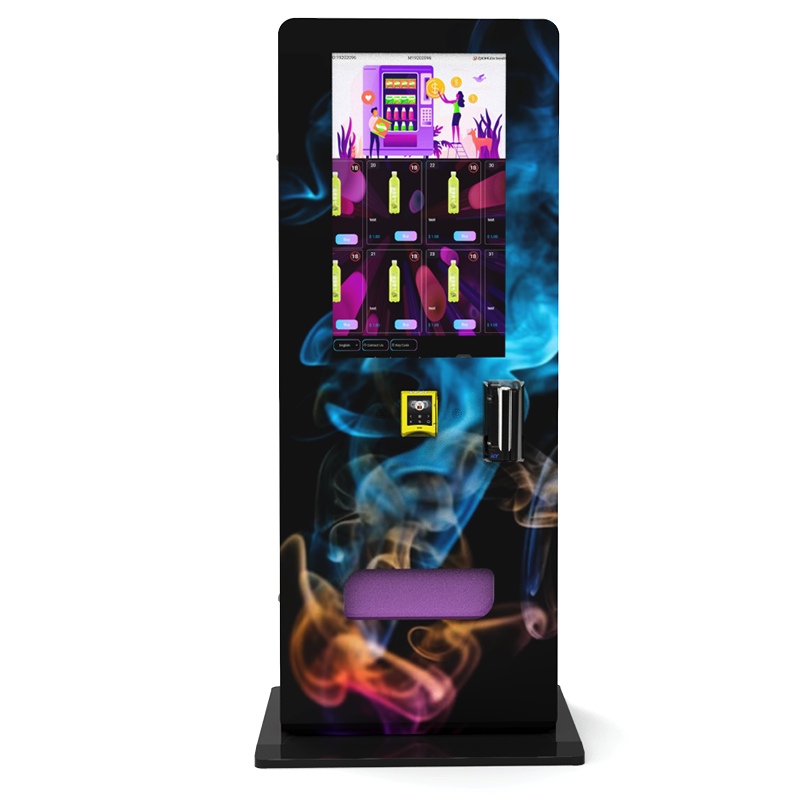
Vape vending machine dimensions depend on the cabinet design, product capacity, payment hardware, age-verification equipment, and dispensing mechanism. A compact wall-mounted unit can preserve valuable floor space, while a full-height machine offers room for more inventory and a larger customer interface. Neither format should be selected by width alone. Buyers need the complete height, width, and depth, plus the clearance required to approach the machine, open its service door, restock products, and maintain the equipment. In this guide, I explain how to compare published specifications, calculate the installation footprint, evaluate different machine formats, and prepare a site before ordering. I also identify the measurements that must be confirmed with the manufacturer rather than estimated from a product photograph.
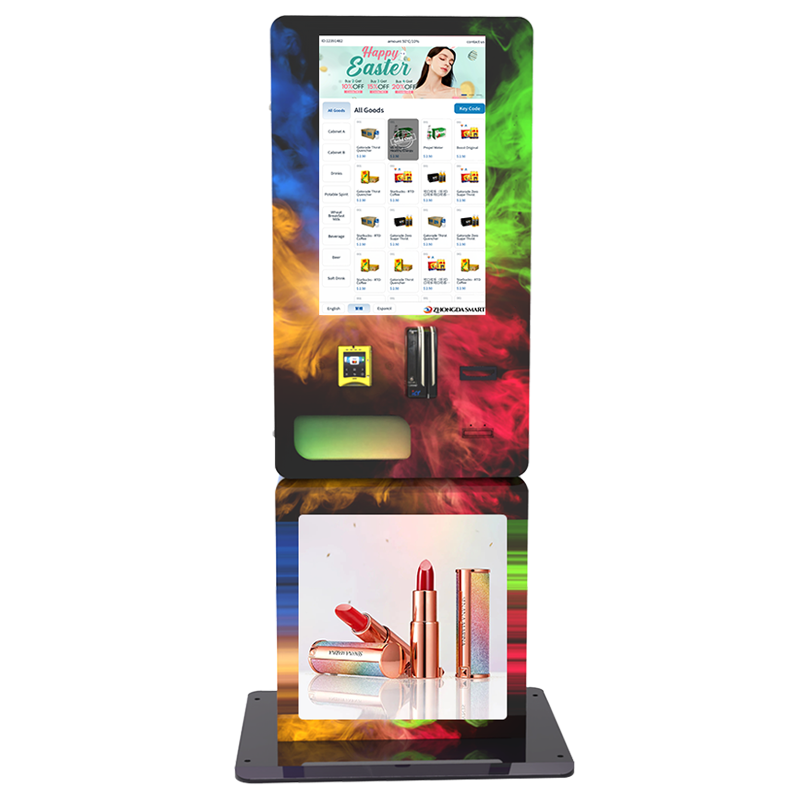
The practical answer: Measure the machine, the space needed to use it, the space needed to service it, and the route required to deliver it. These are four separate measurements.
Cabinet size: The physical height, width, and depth of the complete machine.
Operating clearance: The unobstructed space customers need to approach and use the interface.
Service clearance: The additional room needed for doors, refilling, repairs, and cable access.
Delivery clearance: The route through entrances, corridors, turns, and thresholds that the packaged machine must pass through.
A machine that fits inside a floor plan can still be unsuitable if its service door cannot open, its screen is awkward to reach, or its mounting structure cannot safely support the load.
1. What Vape Vending Machine Dimensions Actually Mean
Manufacturers sometimes publish a single three-number dimension, such as 1,960 × 1,180 × 785 mm. That figure is useful, but only when the measurement order is clear and the specification covers the exact configuration being purchased.
For planning purposes, I separate machine dimensions into several categories. This avoids the common mistake of treating the cabinet's outside measurements as the entire space requirement.
Cabinet height
Cabinet height is the vertical distance from the bottom of the machine to its highest fixed point. Depending on the design, that point may be the cabinet roof, a touchscreen housing, a camera, an antenna, a lighting assembly, or a decorative cover.
Check whether the published measurement includes adjustable feet, a pedestal, a separate display stand, or an optional sign. A machine that is listed as a cabinet-only product may become substantially taller after installation accessories are added.
Height matters for more than ceiling clearance. It affects screen placement, customer reach, visibility from the approach path, loading access, and the ability to move the machine through a doorway.
Cabinet width
Width is the machine's maximum horizontal dimension when viewed from the front. The widest point may be the cabinet itself, a payment terminal, a side-mounted reader, a handle, or a projecting enclosure.
Measure the widest installed configuration rather than the narrowest section of the body. This matters when a machine sits between two walls, beside a door frame, inside a recessed alcove, or against built-in cabinetry.
For a wall-mounted vape vending machine, width also determines where the mounting anchors can be positioned. The wall must accommodate the mounting pattern and the structural support required by the machine, not simply the visible cabinet outline.
Cabinet depth
Depth is the front-to-back measurement. It is often the most underestimated dimension because the cabinet is only one part of the installed projection.
The final projection can include a mounting bracket, rear spacers, a payment terminal, a protruding screen enclosure, a pickup compartment, or other hardware. Cables may require additional space behind or beside the cabinet.
Depth also affects customer movement. A deep cabinet can narrow a passage even when its width appears modest. In a confined installation, a difference of a few inches may determine whether the unit can be used without interfering with nearby fixtures.
Four dimensions that should appear on the installation drawing
| Measurement | What it includes | Why it matters | What to confirm |
|---|---|---|---|
| Overall cabinet dimensions | Maximum fixed height, width, and depth | Determines whether the machine fits the proposed location | Dimension order, accessories, feet, and mounting hardware |
| Operating envelope | Cabinet plus the space required for customer access | Determines whether customers can approach the interface and collect products | Approach direction, reach, pickup location, and accessible clearances |
| Service envelope | Cabinet plus door swing and technician working space | Determines whether staff can refill, inspect, and repair the unit | Door opening angle, tray removal, rear access, and maintenance procedures |
| Delivery envelope | Packaged machine, pallet, protective materials, and handling equipment | Determines whether the equipment can reach the installation point | Shipping dimensions, crate weight, turning space, and lifting requirements |
These measurements should not be combined into one vague phrase such as “required space.” Each serves a different purpose, and the final installation plan needs all four.
2. Published Vape Vending Machine Sizes: What Can Be Verified
There is no single cabinet size that defines every vape vending machine. A small touchscreen unit, a wall-mounted cabinet, and a freestanding machine with several dispensing sections have different physical requirements. Screen size alone does not establish the outside dimensions.
For this comparison, I'm prioritizing specifications that can be tied to a published product page. Where a dimension is not disclosed, the correct answer is to request the current drawing rather than substitute an assumed industry average.
A documented 32-inch touchscreen model
Zhongda Smart's published product page for its 32-inch touchscreen vending machine lists a cabinet size of 1,960 × 1,180 × 785 mm, a weight of 350 kg, a power consumption figure of 500 W, and a stated capacity of 480–960 pieces. The product page does not label the three dimensions by axis, so buyers should confirm which value represents height, width, and depth before planning the installation. View the published 32-inch machine specifications.
| Specification | Published value | Planning interpretation |
|---|---|---|
| Screen size | 32 inches | Describes the display diagonal, not the cabinet width or height |
| Overall size | 1,960 × 1,180 × 785 mm | Approximately 77.2 × 46.5 × 30.9 inches; confirm the axis order |
| Machine weight | 350 kg | Approximately 772 lb; verify the exact shipping and installed weights |
| Power consumption | 500 W | Confirm voltage, current, circuit requirements, and any startup load |
| Stated capacity | 480–960 pieces | Confirm what counts as a piece and which product packaging fits |
These figures are product-specific, not universal measurements for all 32-inch machines. Optional payment devices, structural changes, different dispensing layouts, and branding enclosures can change the finished dimensions. The signed specification for the actual order should take precedence over a general product description.
The published weight deserves particular attention. At approximately 772 lb, this is not a machine that should be treated like a lightweight display cabinet. Delivery planning, floor suitability, lifting equipment, and the route to the installation point need to be addressed before shipment.
Compact and wall-mounted models
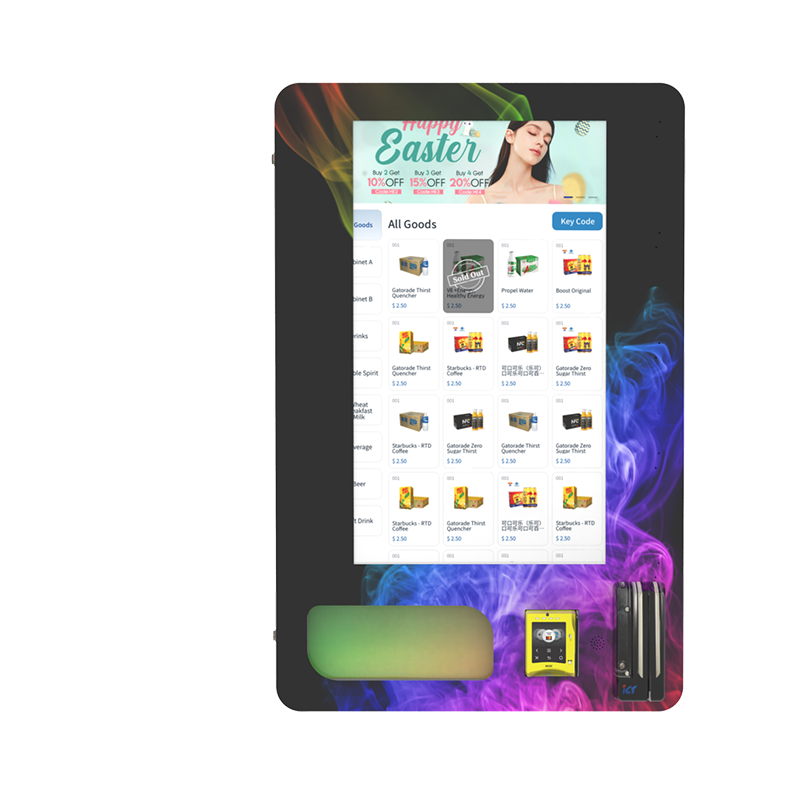
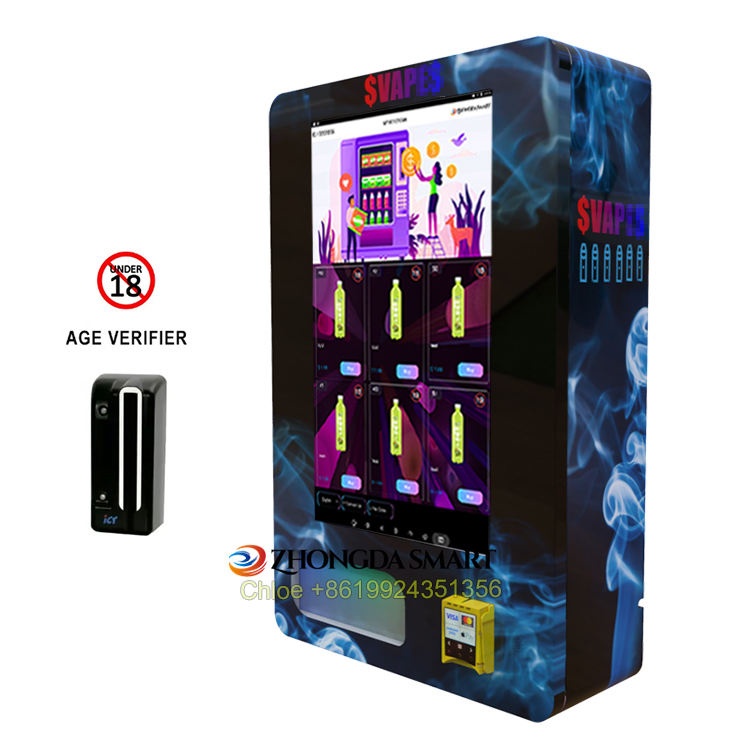
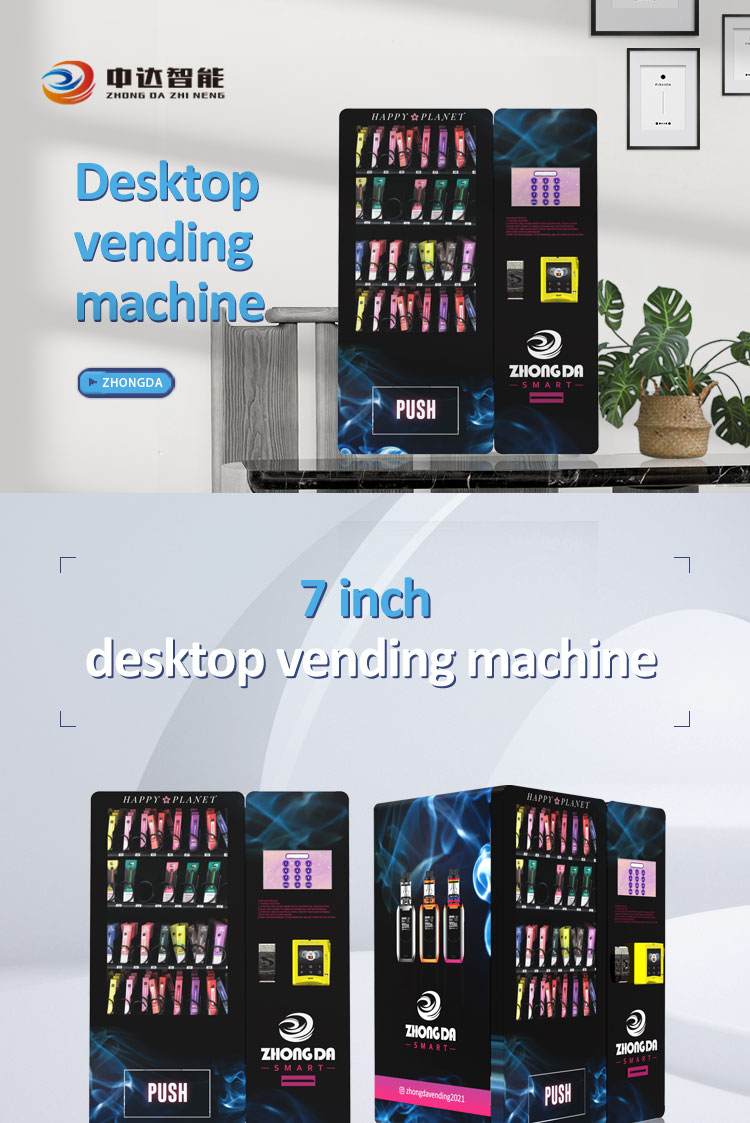
Zhongda Smart also lists a 10.1-inch touchscreen vape vending machine, a mini vending machine with age-verification support, a 7-inch touchscreen model, and a wall-mounted compact e-cigarette vending machine. Their current product descriptions explain available features and customization options, but they do not all publish a complete, order-ready set of external cabinet dimensions.
That distinction is important. A product described as compact is not automatically narrow enough for a specific alcove. A wall-mounted design is not automatically shallow enough for a corridor. A smaller screen does not prove that the machine has a smaller footprint.
| Machine type | What the product information establishes | What must be confirmed before installation |
|---|---|---|
| 10.1-inch touchscreen machine | Touchscreen operation, age-verification-ready configuration, remote monitoring support, and customization options | Exact cabinet height, width, depth, weight, mounting arrangement, and door swing |
| 7-inch touchscreen machine | Compact touchscreen format, payment options, remote management support, and configurable features | Current cabinet drawing, installed projection, capacity by product type, and service access |
| Wall-mounted compact machine | Wall-mounted format and configurable internal product channels | Cabinet projection, loaded weight, anchor pattern, backing requirements, and maintenance clearance |
| 32-inch touchscreen machine | A published overall-size figure, weight, power figure, screen size, and capacity range | Dimension-axis order, final configuration, shipping dimensions, and site-specific installation needs |
For compact installations, I would request the dimensional drawing before evaluating the machine against a floor plan. The current 10.1-inch touchscreen vape vending machine and wall-mounted compact e-cigarette vending machine are useful starting points for that discussion.
3. How to Calculate the Space a Vape Vending Machine Needs
The simplest way to plan an installation is to treat the machine as a physical object surrounded by several functional zones. The cabinet needs to fit, but people also need room to approach it, and technicians need room to work on it.
Start with the approved external dimensions. Then add the clearances required by the installation instructions, applicable accessibility provisions, the door-opening arrangement, and the planned maintenance method.
Step 1: Measure the usable installation area
Measure the available height, width, and depth at the actual proposed location. Do not assume that a wall is perfectly flat or that the floor is level. Check for baseboards, columns, trim, pipes, electrical panels, furniture, door handles, and other objects that reduce the usable area.
For a recessed installation, measure the opening at more than one height. A recess may be wider near the floor and narrower near the top, or its rear wall may not be parallel to the front opening.
Record the smallest usable measurement rather than the largest. A machine needs to clear every restriction along its full height and depth, not just fit through the widest point of the opening.
Step 2: Add the operating clearance
Operating clearance is the unobstructed space in front of and around the machine that allows customers to use it. The required amount depends on the layout, the interface location, the pickup mechanism, and applicable accessibility requirements.
A touchscreen placed on the upper half of a tall cabinet may be comfortable for one customer and awkward for another. A payment reader mounted on the side may require a different approach angle from a reader centered on the front panel.
Consider the entire transaction. Customers may need to read product details, complete age verification, tap or insert a payment method, and retrieve a product. If those steps occur at different points on the cabinet, the usable approach area must accommodate the actual workflow.
Step 3: Add the service clearance
Service clearance is the space needed when the machine is not being used by a customer. A technician may need to open a front panel, remove a tray, reach a payment terminal, inspect wiring, clean a dispensing channel, or replace a component.
A cabinet can fit perfectly into an alcove while remaining impossible to maintain. This is especially problematic when the only service door opens toward a wall or when the internal tray must slide completely out of the cabinet.
Ask the manufacturer which components are accessed from the front, rear, and sides. If routine maintenance requires rear access, a machine installed flush against a wall may need to be moved every time service is required.
Step 4: Account for the installation hardware
Include mounting brackets, feet, a pedestal, stabilizing hardware, cable glands, and any payment or identification equipment that projects beyond the main cabinet. A drawing that shows only the cabinet shell is insufficient for a final layout.
For wall-mounted equipment, the distance between the wall and the cabinet's front surface is particularly important. A thick bracket or spacer can increase the overall projection even if the cabinet itself is shallow.
Step 5: Calculate the full installation envelope
Use these simple planning relationships:
Required installation width = cabinet width + required left clearance + required right clearance.
Required installation depth = cabinet depth + required rear clearance + required front clearance.
Required installation height = overall machine height + any additional top clearance required for installation, ventilation, or service.
These are planning formulas, not fixed clearance standards. The correct allowances come from the approved machine drawing, installation instructions, and applicable building requirements.
Front clearance should not be interpreted as spare space that can automatically be shared with a doorway, queue, storage rack, or unrelated equipment. If two uses compete for the same area, verify that both can function at the same time.
A practical measurement worksheet
| Field measurement | Record |
|---|---|
| Available opening width | ________ inches or mm |
| Available height to the lowest obstruction | ________ inches or mm |
| Maximum usable cabinet depth | ________ inches or mm |
| Required customer approach area | ________ inches or mm |
| Required service-door opening space | ________ inches or mm |
| Rear and side service clearance | ________ inches or mm |
| Doorway and corridor delivery measurements | ________ inches or mm |
| Maximum permitted installed weight | ________ lb or kg |
Complete the worksheet before requesting final confirmation from the supplier. A dimensioned site plan is much more useful than a message saying that the machine must be small enough to fit beside a door.
4. Why Depth Matters More Than Many Buyers Expect
Width is easy to visualize on a floor plan. Depth is less obvious because the machine's projection changes the shape of the space people move through. A narrow machine can still obstruct a circulation path if it extends too far from the wall.
Depth also affects the mounting system, the customer's approach, cable routing, and access to internal components. It should be treated as a primary purchasing criterion, not a secondary specification.
Measure from the wall to the furthest point
For a wall-mounted installation, measure from the finished wall surface to the furthest fixed point on the installed machine. Include the mounting bracket, the cabinet, projecting readers, handles, and any fixed external accessories.
If a payment terminal is mounted at an angle, its outer edge may define the maximum projection. The same applies to a pickup housing or protective enclosure that sits forward of the main body.
Do not assume the advertised cabinet depth includes every accessory. Request a side-view drawing showing the full installed profile.
Account for open doors and removable trays
A service door can require more space than the closed cabinet. Some doors swing outward; others lift, slide, or require a technician to pull an internal tray toward the front.
Ask for the maximum opening angle and the distance that the door or tray projects when fully open. If a removable component is longer than the cabinet depth, confirm that it can be withdrawn without hitting a wall, countertop, or neighboring fixture.
For a floor-standing unit, check whether the rear panel must remain accessible after installation. A cabinet that can be serviced only from the rear needs enough room to make that possible, or a documented alternative service method.
Allow for cables without creating a hazard
Power and data connections can require clearance behind or beside the machine. A recessed outlet, a right-angle plug, or a cable exit through the cabinet base can change the required installation depth.
Do not solve a clearance problem by sharply bending a power cable or crushing it between the cabinet and the wall. Follow the manufacturer's cable-routing instructions and applicable electrical requirements.
Cables should not cross a customer walking path unless the installation has been specifically designed and approved for that arrangement. A neat cable route improves both safety and maintenance access.
Check the effect on nearby traffic
Imagine the machine in use rather than looking only at the empty floor plan. A customer standing in front of the screen occupies space beyond the cabinet. A second customer may wait behind them, and a staff member may approach to refill stock.
In a narrow passage, that interaction can create congestion even if the cabinet technically fits. I would choose a shallower configuration when the site cannot provide adequate front clearance, provided the machine still accommodates the intended products and required functions.
The objective is not simply to minimize depth. It is to keep the complete installation functional without forcing customers, staff, or nearby occupants into an awkward route around the machine.
5. Wall-Mounted, Countertop, and Freestanding Machines Compared
Machine format is one of the strongest predictors of how much space an installation will need. Each design solves a different problem, and the correct choice depends on available space, product assortment, structural conditions, service access, and expected sales volume.
| Format | Space advantage | Main dimensional concern | Best evaluation criteria |
|---|---|---|---|
| Wall-mounted | Uses wall area rather than a separate floor footprint | Projection, mounting height, wall strength, and anchor placement | Loaded weight, bracket drawing, cable route, and front service access |
| Countertop or desktop | Uses an existing counter or purpose-built support | Counter depth, working height, support capacity, and overhang | Base dimensions, loaded weight, counter stability, and customer reach |
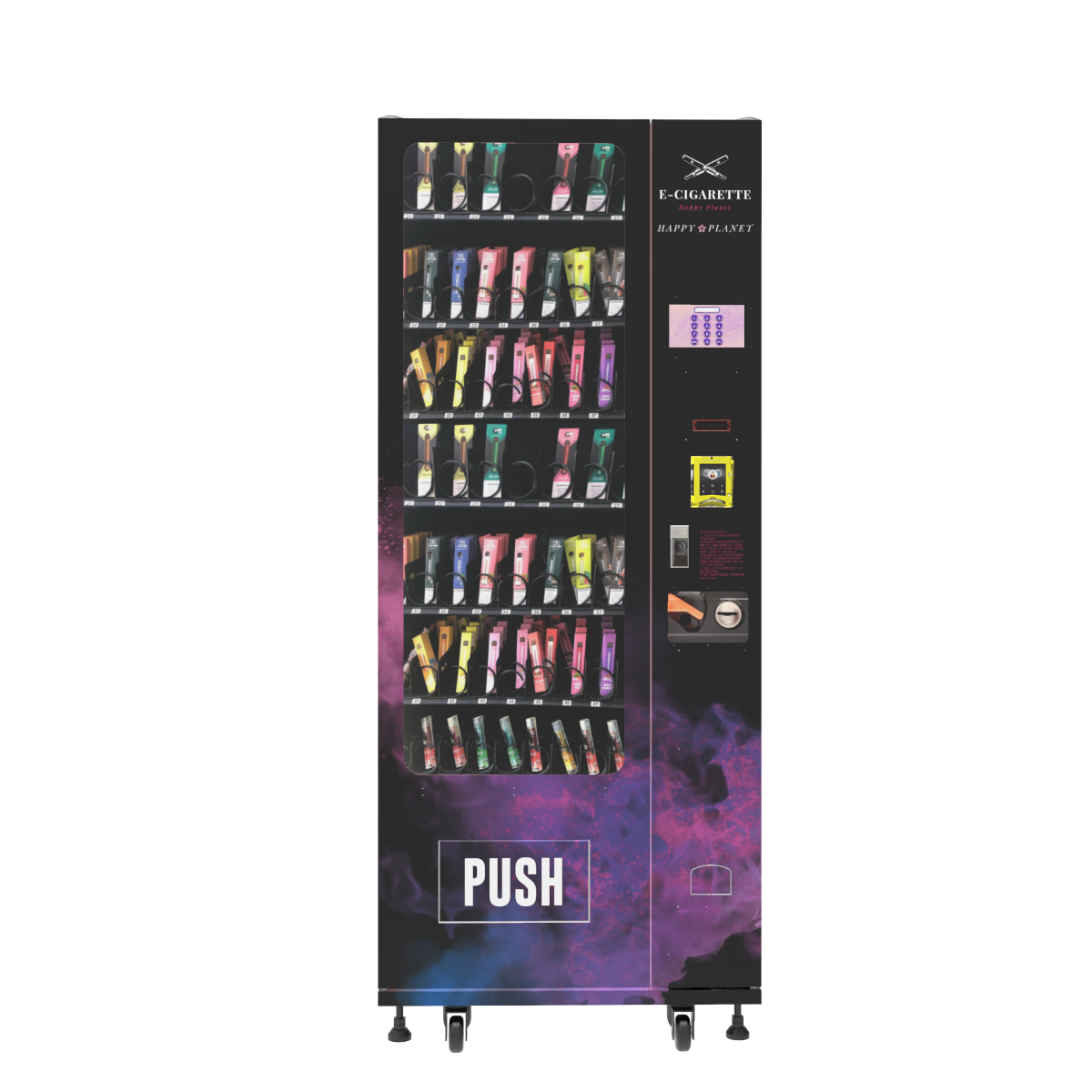
| Freestanding compact | Combines a dedicated cabinet with a relatively contained footprint | Full cabinet depth, door swing, stability, and restocking space | External dimensions, capacity, floor loading, and service-door movement |
| Large freestanding | Can accommodate a larger interface and more product channels | Delivery route, floor capacity, circulation clearance, and handling equipment | Overall size, shipping dimensions, weight, dispensing layout, and maintenance access |
When a wall-mounted machine makes sense
A wall-mounted vape vending machine can be a sensible choice when floor space is expensive or the available area is narrow. It may also create a cleaner installation by keeping the cabinet away from floor-level obstacles.
However, wall mounting does not eliminate the space requirement. It transfers part of the design problem to the wall structure and mounting hardware.
The mounting surface must support the installed load with an appropriate safety margin determined by the responsible installer or engineer. The mounting pattern must align with suitable structural backing, and the finished installation must accommodate the machine's operating and service envelopes.
I would not approve a wall-mounted unit based on a cabinet photograph and a nominal weight alone. The supplier should provide the mounting-hole pattern, bracket details, installed projection, and loaded-weight information.
When a countertop machine makes sense
A countertop unit may suit a project with an existing service counter or a dedicated, purpose-built stand. It can be useful when the machine needs to remain accessible to staff for monitoring or restocking.
The counter must support the actual installed weight, including products and accessories. A machine that looks compact can still create a substantial concentrated load over a relatively small base.
Check the depth of the base against the counter surface. An overhanging cabinet can interfere with customers, leave the machine unstable, or create an obstruction beneath the front edge.
Also consider the finished operating height. A counter that is comfortable for staff may position the screen or pickup point too high for some customers. If accessibility requirements apply, the full arrangement must be assessed rather than judging the machine in isolation.
When a freestanding machine makes sense
A freestanding unit generally offers more freedom in placement because it does not depend on a wall bracket or existing countertop. Depending on the design, it may also provide more internal space for dispensing channels and a larger customer interface.
The trade-off is a larger occupied floor area, potentially greater weight, and more demanding delivery and installation arrangements. The full cabinet must fit through the delivery route, and the final position must leave room for customers and maintenance staff.
For a high-capacity model, I would assess the floor plan, service envelope, and loading route before comparing cosmetic features. If the installation is awkward, the additional capacity may not justify the operational inconvenience.
6. Accessibility, Customer Approach, and Safe Clearances
Space planning should consider how a customer approaches the machine, reaches the controls, completes payment, and collects the product. A machine is not well placed simply because its cabinet is inside the marked installation area.
The Access Board's ADA Standards include provisions for vending machines and operable parts. The standards specify that, where vending machines are provided, at least one of each type must comply with the applicable operable-part requirements. The standards also describe clear floor space and reach ranges. The precise obligations depend on the facility, the equipment, and the applicable provisions. Review the ADA Accessibility Standards. [2]
Use clear floor space as a design check
The Access Board's general clear-floor-space provisions specify a minimum area of 30 inches by 48 inches for applicable elements. This is a useful dimensional reference when evaluating the customer approach, but it is not a universal statement that every vending installation is compliant merely because this rectangle fits.
The approach area must be positioned correctly relative to the operable parts. An alcove, a neighboring fixture, or an obstruction on multiple sides can affect the required maneuvering space. The final layout should be checked against the applicable accessibility provisions rather than using a simplified diagram as a substitute for review.
Pay attention to control height and reach depth
The ADA Standards specify an unobstructed forward or side reach range of 15 to 48 inches for applicable operable parts, subject to the detailed requirements and exceptions in the standards.
The location of the touchscreen, payment terminal, identification reader, and pickup control therefore deserves attention during product selection. A screen mounted within the nominal range may still be difficult to use if the customer must reach across a deep obstruction.
Reach depth matters as much as reach height. The further a control sits behind the front edge of the available clear floor space, the more important it becomes to check the specific reach provisions. A machine should not be approved solely because its touchscreen appears to sit at a comfortable height in a product image.
Keep the approach area clear during normal operation
Do not use the customer approach area as a temporary stockholding space. Boxes, refill carts, promotional stands, waste bins, and unrelated furniture can turn a workable installation into an obstructed one.
The pickup compartment also needs to be considered. If the customer must bend, reach around the side of the cabinet, or stand in a doorway to retrieve a product, the placement deserves another look.
For a machine that serves an adult-only retail environment, age verification and the legal conditions for unattended sales must also be considered before a location is approved. Physical dimensions cannot make an otherwise prohibited installation acceptable.
Protect circulation paths and exits
A machine should not create an obstruction in a required exit route or interfere with the normal operation of doors, safety equipment, or other building fixtures. The cabinet's outer edge is only part of the assessment; a customer standing in front of the machine can occupy additional space.
Consider the busiest likely period rather than the quietest moment. A placement that leaves sufficient room for one person may not work when another person is waiting or a technician is refilling the cabinet.
If the only available position creates a conflict with pedestrian movement, choose another location or a different machine format. Moving a unit a short distance can be more effective than attempting to solve a poor layout with signs or floor markings.
7. Product Capacity, Channel Dimensions, and the Real Use of Internal Space
External dimensions tell you how large the machine is. Internal channel dimensions tell you what it can sell. Both matter, and they should be evaluated together.
A vending machine with a larger cabinet does not automatically deliver more useful capacity. Internal space may be occupied by the touchscreen, payment equipment, control electronics, structural members, dispensing mechanisms, and access panels. The remaining space must accommodate products in a way that allows reliable dispensing.
Measure the products before finalizing the cabinet
Prepare a product list containing the packaged height, width, depth, and weight of every intended stock-keeping unit. Include packaging variations and any protective sleeve or display box that will remain on the product during dispensing.
Measure the actual retail package rather than relying on the dimensions of the product inside it. A disposable vape, a pod pack, a boxed device, and a small accessory can have different packaging requirements even if they belong to the same product category.
For each item, ask the manufacturer to confirm the compatible dispensing channel and the usable dimensions of that channel. The minimum opening should account for the product's orientation and the clearances needed for reliable movement through the dispensing mechanism.
Distinguish item capacity from SKU capacity
Capacity figures can be misleading when their meaning is not defined. A statement such as 480–960 pieces does not necessarily mean the machine can carry 480–960 different products or product types.
Several identical items may occupy separate positions in one channel. The total item count may therefore be high while the number of distinct product selections remains relatively modest.
When comparing two machines, ask for three separate figures:
Total item capacity: The number of sellable units the machine can hold under the stated loading arrangement.
SKU capacity: The number of distinct products or selections supported by the internal layout.
Capacity by package type: The quantity possible when the intended product mix is loaded in the actual dispensing channels.
The third figure is especially important. A theoretical maximum based on small packages may not apply when the assortment contains larger boxes or products that require different channel configurations.
Check the dispensing path, not just the storage opening
A package can fit inside a channel and still fail to dispense reliably. The product may tilt, catch on an edge, move out of position, or become trapped near the pickup mechanism.
Ask the manufacturer how the dispensing system handles the exact package dimensions and orientations. Confirm the intended loading direction, the maximum package weight, the dispensing mechanism, and the procedure for testing new products.
If the assortment is likely to change, request a configuration that can accommodate the planned range of packaging sizes. Adjustable channels can be useful, but the available adjustment range should be documented rather than assumed.
Leave room for practical restocking
Capacity is not the only inventory consideration. A tightly packed machine may take longer to refill, make individual products harder to identify, or require additional care when removing and replacing trays.
Evaluate how the operator accesses the stock, how quickly an empty channel can be replenished, and whether the machine reports inventory at the level needed for routine management. The best internal arrangement is the one that supports the intended product mix and a repeatable restocking process.
Before approving production, ask for a channel layout showing the proposed SKU arrangement. A drawing or loading schedule is more useful than a headline capacity figure when the machine will carry several product formats.
8. Electrical Requirements, Weight, Wall Strength, and Environmental Conditions
Installation space is not only a question of geometry. A machine also needs an appropriate electrical supply, a suitable supporting surface, and environmental conditions consistent with its design.
Confirm the actual electrical rating
The published specification for the 32-inch Zhongda Smart model lists 500 W of power consumption. That figure belongs to the listed configuration; it should not be applied to every machine in the product range.
For a simple illustration, 500 W divided by 120 V is approximately 4.2 A, while 500 W divided by 230 V is approximately 2.2 A. These calculations are arithmetic examples, not a circuit-sizing recommendation. They do not account for power factor, startup behavior, the full electrical specification, or other equipment on the circuit.
Ask the manufacturer to provide the rated voltage and frequency, rated current, power consumption, plug type, grounding requirements, and any special circuit requirements. The installer should use the machine's actual electrical documentation and the applicable electrical rules.
Do not position the machine where its power connection is inaccessible or where the cable must pass through an unsuitable route. Leave the access required to disconnect and service the unit safely.
Evaluate the installed weight
A machine's weight affects delivery, lifting, floor loading, anchoring, and maintenance. The published 350 kg figure for the 32-inch model is a reminder that a seemingly ordinary retail cabinet may require specialist handling.
Confirm whether the quoted weight is the empty machine weight, the fully loaded operating weight, or another figure. Request the packaged weight separately because shipping materials and a pallet can increase the weight and overall dimensions of the delivery.
For a heavy floor-standing unit, the installation team should verify that the supporting floor can accommodate the load and that the proposed movement route is suitable. Where necessary, a qualified professional should assess the floor and handling arrangements before delivery.
Check wall construction before choosing a wall-mounted model
A wall-mounted vending machine transfers its load to the mounting structure. The strength of the finished wall, the location of structural members, the anchor specification, and the bracket arrangement all influence whether the proposed position is suitable.
Do not assume that a wall finish is structural support. The mounting system must be appropriate for the actual substrate and the installed load, with the necessary safety factors determined by the responsible designer or installer.
Request the mounting-hole pattern, bracket dimensions, fastener requirements, and permitted installation surfaces. If the wall construction is uncertain, have it assessed before drilling.
Also consider service forces. Opening a door, pulling out a tray, or working on a cabinet can introduce forces beyond the machine's static weight. The mounting design must account for the actual installation and maintenance method.
Plan for ventilation and operating conditions
Clearance requirements vary by machine design. Some equipment needs a defined gap around a ventilation opening or heat-producing component; other configurations have different cooling arrangements.
Do not invent a universal ventilation clearance. Ask the manufacturer for the required free space around the cabinet and identify any vents that must remain unobstructed.
Avoid placing equipment where cleaning fluids, moisture, direct heat, or physical impacts could create a problem unless the machine has been designed for those conditions. If an installation is exposed to weather or an unusually demanding environment, obtain written confirmation that the selected model is rated for that use.
UL 751 is a relevant product-safety standard to discuss when evaluating commercial vending equipment. Its published scope covers self-contained, payment-accepting vending machines and states that equipment is intended for indoor use unless outdoor or protected-location use is specifically designated by the manufacturer. Buyers should confirm the applicable safety evaluation and intended-use rating for the exact model. Read the UL 751 standard overview. [4]
9. How to Choose the Right Size for the Business
The correct machine size should follow the sales plan and installation constraints. Buying a larger cabinet simply because it holds more products can create unnecessary cost and operational complexity. Buying a compact unit without checking the product assortment can leave the operator short of useful capacity.
For this comparison, I'm prioritizing five practical factors: the usable product capacity, the complete installation envelope, the ability to verify age where required, the maintenance arrangement, and the total installed cost.
For a location with very limited floor space
Start with wall-mounted or compact formats, then confirm the exact dimensions. Check whether the unit can be mounted safely and whether the customer approach area remains clear.
Do not assume a wall-mounted cabinet is the best option if the wall cannot support it or if service requires access from the rear. A freestanding machine with a narrow body may be more practical in some layouts, depending on the available floor area.
For a location with a broader product assortment
Compare internal channel arrangements before selecting a larger cabinet. A machine that supports the intended package sizes and product mix can be more useful than a nominally larger unit with incompatible dispensing channels.
Request a capacity estimate based on the actual assortment. The supplier should identify any channel changes or special configurations required to accommodate the products.
For a high-volume operation
Assess replenishment and service access alongside capacity. A machine may hold a large quantity of stock, but a poor loading arrangement can increase the time required to replenish it.
Remote inventory monitoring, sales reporting, and alerts may help operators schedule restocking more efficiently. Verify which functions are included in the quoted configuration and whether any software or connectivity fees apply.
Use a consistent supplier evaluation framework
| Evaluation criterion | Evidence to request | Why it matters |
|---|---|---|
| Dimensional accuracy | Dimensioned general-arrangement drawing for the exact model | Prevents installation errors caused by incomplete or ambiguous measurements |
| Capacity suitability | Channel layout and capacity estimate using actual product packaging | Connects advertised capacity to the planned inventory |
| Structural suitability | Empty and loaded weight, mounting details, and support requirements | Helps establish whether the wall, counter, or floor can support the machine |
| Electrical suitability | Voltage, frequency, rated current, power, and connection details | Allows the installer to prepare the correct supply |
| Maintenance access | Door-swing diagram, tray-removal details, and service instructions | Reduces the risk of a machine that cannot be serviced in place |
| Age verification | Supported verification method, operating workflow, and test procedure | Helps assess whether the configuration can support the intended sales controls |
| Payment integration | Payment hardware, accepted methods, network needs, and recurring fees | Identifies installation requirements and ongoing costs |
| After-sales support | Warranty terms, spare-parts availability, and support procedure | Helps evaluate the long-term cost of keeping the machine operational |
I would rank a supplier with clear drawings, documented specifications, and a defined commissioning process above a supplier offering only a low headline price. Dimensional errors can lead to rework, relocation, or a failed installation, and those costs may exceed the apparent savings from the original purchase.
10. Zhongda Smart Product Options Worth Comparing
Zhongda Smart offers several machine formats, including touchscreen models, compact machines, wall-mounted configurations, and larger freestanding equipment. The right option depends on the product assortment and the installation envelope, not on screen size alone.
The following options are useful starting points for a specification review. The product cards link to the corresponding published pages; the final dimensions and configuration should be confirmed in the quotation and approved drawing.
7-Inch Touchscreen Mini Vending Machine
A compact-format option to evaluate when floor space is constrained and the intended assortment can be supported by the proposed dispensing layout.
7-inch touchscreen interface
Payment and remote-management options
Configurable features and branding
Current cabinet dimensions should be confirmed
Best next step: request the current dimensioned drawing, installed weight, and channel layout.
View 7-Inch Model
32-Inch Touchscreen Vending Machine
A larger-format machine for projects that need a prominent display and a higher stated product capacity. Its published specification provides a useful starting point for dimensional planning.
32-inch touchscreen
Published size: 1,960 × 1,180 × 785 mm
Published weight: 350 kg
Published power figure: 500 W
Best next step: confirm the height-width-depth order, exact configuration, shipping dimensions, and floor requirements.
View 32-Inch ModelBuyers who need a smaller cabinet can also compare the 10.1-inch touchscreen model and review the complete vape vending machine lineup. Ask the supplier to recommend a configuration against the actual site measurements rather than selecting a model from a product photograph alone.
11. What to Include in a Manufacturer's Dimensional Drawing
A useful general-arrangement drawing should answer the installation questions before the machine is manufactured or shipped. A simple front-view photograph is not enough for a project that depends on precise clearance.
Request the following information for the exact model and selected options:
Overall height, width, and depth, with each axis labeled.
Maximum installed projection, including brackets, readers, handles, and other fixed accessories.
Cabinet weight, fully loaded weight, and packaged shipping weight.
Base dimensions, adjustable-foot range, and any pedestal or stand dimensions.
Wall-mounting hole pattern, bracket drawing, anchor requirements, and permitted mounting surfaces, if applicable.
Front, rear, and side service-door locations, including opening direction and maximum travel.
Required ventilation clearances and the location of air inlets or outlets, where applicable.
Power inlet, cable exit, network connection, and any required external accessories.
Customer interface positions, including the touchscreen, payment reader, identification reader, and product pickup point.
Internal channel dimensions and the approved package sizes for the intended assortment.
Required tools, lifting points, and handling instructions for delivery and installation.
Any changes to dimensions caused by customization, payment equipment, branding, or other options.
Ask for the revision date and model identifier on the drawing. If the quotation refers to one model but the drawing shows another, resolve the discrepancy before approving production.
Request both the closed and service-open views
The closed-cabinet drawing establishes the physical envelope. The service-open drawing establishes whether the equipment can be maintained after installation.
For a machine with removable product trays, request the tray's withdrawal distance. For a machine with a rear service panel, ask whether the panel can be removed without moving the cabinet. For a wall-mounted unit, confirm that the service method does not place excessive force on the mounting system.
These details are easy to overlook during procurement because they do not always appear in the marketing specifications. They can become expensive problems once the machine is installed.
12. Site Preparation and Delivery Planning
The installation location is only the final part of the route. A machine must also pass through the building and reach the intended position without damage or an unsafe handling operation.
Measure the entire delivery route
Check the narrowest doorway, the height beneath door closers, corridor width, turns, ramps, thresholds, and any elevator or lift that must be used. Measure the packaged machine if the shipping dimensions are larger than the bare cabinet.
A long cabinet can pass through a doorway in one orientation but fail at a tight turn immediately afterward. The delivery team may need room to rotate the machine, position a trolley, or operate lifting equipment.
Do not use the uncrated dimensions to approve the delivery route unless the supplier confirms that the machine will arrive without packaging and that the handling arrangement is suitable.
Confirm handling equipment and access
Ask whether the machine requires a pallet jack, forklift, lift gate, or other handling equipment. Confirm that the equipment can reach the installation point and that the floor, thresholds, and access openings can accommodate the load.
For a heavy cabinet, the installation method should be established before shipment. Do not rely on improvised lifting or assume that several people can safely move the machine by hand.
Prepare the electrical and network connections
Identify the intended outlet, confirm the electrical specification, and check the cable route before the machine arrives. If remote monitoring or payment processing requires a network connection, confirm the supported connectivity method and test the signal or connection at the installation point.
Keep outlets and connections accessible for inspection and maintenance. Avoid placing the machine where a plug, cable, or network connection becomes trapped behind a fixed panel.
Check the finished position before final fixing
Before anchoring a wall-mounted machine or permanently positioning a heavy freestanding unit, compare the actual location with the approved drawing. Confirm the final projection, approach area, door swing, cable route, and maintenance access.
For a wall-mounted unit, verify the mounting surface and anchor positions before drilling. For a freestanding machine, confirm that the base is stable and the supporting floor is suitable.
Complete the installation only after the responsible installer has confirmed that the mounting, electrical connections, and required clearances meet the applicable instructions and requirements.
13. Machine Dimensions, Purchase Cost, and Return on Investment
Machine size affects more than the initial equipment price. It can change shipping costs, handling requirements, installation labor, product capacity, replenishment frequency, and the amount of floor area committed to the machine.
A compact model may reduce installation complexity, but it may also hold less stock or provide fewer product selections. A larger model may offer more capacity while introducing greater delivery, structural, and service requirements.
Compare the total installed cost
Ask for an itemized quotation that separates the equipment price from the additional costs associated with the project. The quotation should identify which hardware and services are included and which are optional.
| Cost category | Questions to ask |
|---|---|
| Machine and cabinet | Does the price cover the exact dimensions, dispensing configuration, and selected options? |
| Age-verification hardware | Is the required verification equipment included, and are there recurring software or service charges? |
| Payment system | Which terminal is included, which payment methods are supported, and what fees apply? |
| Shipping and handling | Are freight, packaging, delivery, unloading, and special handling included? |
| Installation | Does the quote include mounting hardware, electrical work, commissioning, and site preparation? |
| Connectivity and software | Are network access, cloud management, transaction reporting, and support charged separately? |
| Maintenance and spare parts | What warranty applies, which parts are covered, and what are the expected service charges? |
| Site costs | Are there installation fees, venue commissions, additional floor-space costs, or required structural work? |
Do not compare two machines on cabinet price alone if one requires substantially more installation work. The more useful comparison is the total cost of getting each option installed, approved for its intended use, and ready to operate.
Use a transparent payback calculation
Simple payback is calculated by dividing the total installed investment by the monthly contribution generated by the machine after the costs included in the calculation have been deducted.
Simple payback period = total installed investment ÷ monthly contribution.
Monthly contribution = sales revenue − product costs − payment fees − venue commissions − connectivity and software charges − maintenance allowance − other operating expenses included in the model.
Illustrative arithmetic only: If a hypothetical installation costs $6,000 in total and generates a hypothetical monthly contribution of $1,000, simple payback is six months. These figures are example inputs, not a machine price, industry average, or forecast of actual results.
Use realistic sales assumptions for the specific location, actual supplier quotations, and a clearly defined operating-cost model. A larger machine should not be assumed to produce more sales merely because it can hold more products.
Capacity is valuable only when the additional stock can be sold at an adequate contribution margin. A smaller machine with a suitable assortment may be financially preferable to a larger cabinet that ties up cash in slow-moving inventory.
Include the cost of a poor fit
A dimensional error can create costs that do not appear in the original equipment quotation. These may include redesigning the installation, changing mounting hardware, hiring additional handling equipment, relocating the cabinet, or modifying the surrounding space.
Before committing to a model, compare the supplier's drawing with the site measurements and delivery route. The time spent confirming dimensions is part of purchasing due diligence, not an unnecessary delay.
14. Common Sizing Mistakes to Avoid
Mistake 1: Treating screen size as machine size
A 32-inch touchscreen refers to the diagonal measurement of the display. It does not tell you the width, height, or depth of the complete machine. The cabinet may extend well beyond the screen in one or more directions.
Better approach: Use the complete external dimensions of the exact model, including any separate base or stand.
Mistake 2: Assuming every compact model has the same footprint
Product names such as mini, compact, and desktop describe broad form factors, not standardized dimensions. Payment hardware, internal capacity, cabinet construction, and customization can change the final measurements.
Better approach: Request the current dimensioned drawing and confirm the model number in writing.
Mistake 3: Measuring only the closed cabinet
A machine may fit when its doors are shut but leave no room for restocking or maintenance. This is especially common in recessed installations and wall-mounted configurations with limited access.
Better approach: Check the operating and service envelopes separately, including the full travel of doors and removable trays.
Mistake 4: Ignoring the mounting structure
A wall-mounted machine can look small enough for a narrow wall but still be unsuitable for the available structure. Mounting hardware, the loaded weight, and the position of structural backing all matter.
Better approach: Confirm the installed weight, anchor pattern, mounting instructions, and suitability of the actual wall.
Mistake 5: Confusing total capacity with product variety
A machine advertised for hundreds of pieces may hold many units of the same product. That does not guarantee sufficient space for the number of distinct selections the operator wants to offer.
Better approach: Obtain a proposed channel layout based on the real assortment and the dimensions of each packaged product.
Mistake 6: Forgetting the delivery route
A cabinet can fit the final installation area and still be impossible to move through a doorway or turn around a corridor corner in its packaged state.
Better approach: Compare the packed dimensions and handling requirements with every restriction along the delivery route.
Mistake 7: Accepting an unlabeled three-number dimension
A specification such as 1,960 × 1,180 × 785 mm is incomplete for installation planning if the manufacturer has not identified the axis order. Guessing which number represents height or depth can invalidate the entire layout.
Better approach: Obtain a drawing with labeled height, width, and depth, plus the projection of installed accessories.
Mistake 8: Assuming a machine feature guarantees legal compliance
An age-verification-ready cabinet does not automatically satisfy every requirement for selling age-restricted products. Permitted locations, verification procedures, product eligibility, and operating rules must be assessed separately.
Better approach: Confirm the applicable sales requirements and test the complete verification workflow before the machine is placed into service.
15. A Pre-Order Checklist for Vape Vending Machine Dimensions
Before paying a deposit or approving production, complete the following checks. This process helps align the selected cabinet with the actual installation conditions and reduces the risk of avoidable changes later.
Model identity: Confirm the exact model number, screen size, dispensing system, and configuration.
Dimensioned drawing: Obtain a current drawing showing overall height, width, and depth with the axis order clearly labeled.
Installed projection: Confirm the maximum depth with brackets, readers, handles, and accessories installed.
Door movement: Verify that service doors and trays can open or be removed without hitting surrounding objects.
Operating area: Check customer approach, screen reach, payment access, and product pickup clearance.
Structural support: Verify floor capacity or wall-mounting suitability for the actual installed load.
Electrical specification: Confirm voltage, frequency, rated current, power requirements, and cable access.
Product compatibility: Provide the manufacturer with actual package measurements and obtain a suitable channel layout.
Delivery route: Check packaged dimensions, weight, doorway widths, corridor turns, thresholds, and handling equipment.
Age verification: Confirm the required verification hardware and the complete transaction workflow.
Operating costs: Identify software, payment, connectivity, maintenance, and spare-parts costs.
After-sales support: Obtain written warranty terms, service arrangements, and parts availability.
Final approval: Compare the approved drawing with the measured site and resolve discrepancies before shipment.
If the project includes custom cabinet dimensions, request written confirmation that the final production drawing reflects the approved measurements. A verbal assurance that the machine can be customized is not a substitute for a documented specification.
16. Final Recommendation: Choose the Machine That Fits the Entire Operation
The best vape vending machine dimensions are not necessarily the smallest or largest. They are the dimensions that accommodate the intended products, fit the installation area, provide practical customer access, and leave enough room for reliable maintenance.
For a restricted installation, I'd recommend beginning with a compact or wall-mounted model and confirming the full installed projection, structural requirements, and service method. For a project that needs a larger touchscreen and higher stated capacity, I'd evaluate a freestanding model against the actual floor plan, delivery route, and loaded weight.
In either case, the manufacturer should supply a drawing that identifies the cabinet dimensions, accessory projection, service-door movement, mounting details, and electrical connections. If those details are unavailable, the machine is not ready for a final site approval.
Zhongda Smart's product range provides several formats to compare, from compact touchscreen units to larger freestanding machines. The most useful next step is to submit the available installation dimensions, intended product packaging, and required features so the proposed configuration can be checked against the actual site.
Before you order: Confirm the current specification for the exact model, obtain the dimensional drawing, and verify the site conditions with the responsible installer. Do not use an illustrative photograph or an unlabeled size figure as the final installation reference.
Frequently Asked Questions
1. What are the standard dimensions of a vape vending machine?
There is no single standard size for every vape vending machine. Dimensions vary by cabinet format, screen, dispensing system, payment hardware, and product capacity. Ask the manufacturer for the exact height, width, and depth of the selected model. Compact and wall-mounted machines should not be assumed to share the same dimensions.
2. How much space does a vape vending machine need?
The required space includes the cabinet footprint, customer approach area, service clearance, and any additional space needed for mounting hardware or cables. The delivery route must also accommodate the packaged machine. Calculate each area separately using the approved drawing and the applicable installation requirements.
3. How deep is a wall-mounted vape vending machine?
Depth varies by model and configuration. The installed projection may include the cabinet, bracket, payment terminal, and other fixed accessories. Ask for a side-view drawing showing the distance from the finished wall to the furthest point of the installed machine. Also confirm the required service access.
4. Are compact vape vending machines suitable for narrow spaces?
They can be suitable when the complete cabinet fits and the installation still provides adequate customer access, service clearance, and structural support. A compact product description alone does not establish suitability. Compare the exact machine dimensions with the measured opening and verify that the service door can operate as intended.
5. How do I determine whether a vending machine will fit through a doorway?
Obtain the packaged dimensions and weight, then measure the narrowest doorway, corridor, turn, threshold, and lift along the delivery route. Check whether the machine can be rotated safely at corners and whether the required handling equipment can reach the installation point. Do not rely solely on the uncrated cabinet dimensions.
6. How much clearance is needed in front of a vape vending machine?
The required clearance depends on the machine's interface, pickup arrangement, service method, and applicable accessibility and building requirements. The Access Board's general clear-floor-space provisions specify 30 by 48 inches for applicable elements, but this figure does not by itself establish that every installation complies. Check the actual layout and applicable provisions.
7. Does a larger touchscreen mean a larger vending machine?
Not necessarily. Screen size is measured diagonally and does not establish the cabinet's overall dimensions. Two machines with similar displays can have different heights, widths, depths, and internal capacities. Compare the complete external measurements and the dispensing layout rather than selecting by screen size alone.
8. What should I ask a manufacturer before buying a vape vending machine?
Request a dimensioned drawing, empty and loaded weight, shipping dimensions, mounting requirements, door-swing details, electrical ratings, channel layout, product compatibility, age-verification options, payment specifications, warranty terms, and after-sales support details. Confirm that the final drawing matches the exact configuration being quoted and the measured installation area.
Sources and Technical References
The dimensional guidance above distinguishes published product specifications from installation-planning recommendations. The following sources provide the product data and technical references used in this guide.
Zhongda Smart — 32-Inch Touchscreen Vending Machine with Age Verification. Published model specifications, including the listed overall size, weight, power consumption, screen size, and stated capacity. View product specifications.
Access Board — ADA Accessibility Standards. Reference for applicable vending-machine operable-part provisions, clear floor space, and reach requirements. Read the standards.
Food and Drug Administration — Selling Tobacco Products in Retail Stores. Guidance covering age restrictions, identification checks, and vending-machine restrictions for covered tobacco products, including e-cigarettes. Read the retail guidance.
UL Standards & Engagement — UL 751, Vending Machines. Product-safety standard scope and information about the intended use of commercial vending equipment. View the standard overview.
Disclaimer
This guide is intended for general equipment-selection and installation-planning purposes. Published specifications may change by model, production revision, and configuration. Approximate unit conversions and illustrative financial calculations are provided for planning only and are not guarantees of machine performance, operating costs, or investment returns.
Always obtain the current manufacturer-approved drawing and technical documentation before purchasing, installing, or modifying a machine. Structural support, electrical work, accessibility, fire and building requirements, age verification, and the sale of age-restricted products must be assessed against the rules applicable to the specific installation. Product descriptions and age-verification features do not, by themselves, establish legal compliance. Consult qualified professionals where required.